
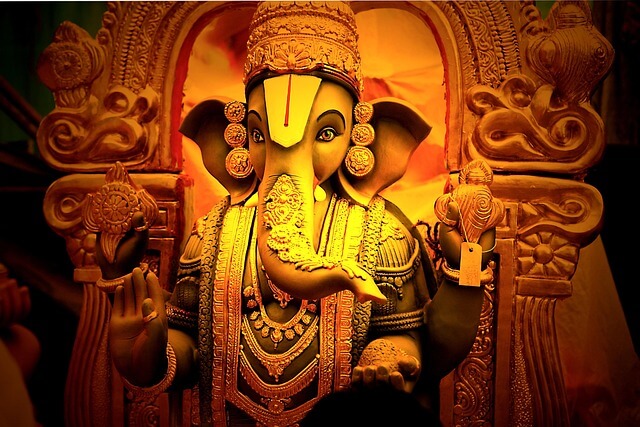
Some food was being sacrificed to idols. So should they eat it or not? Paul had first established that love for God was going to be the guardrails of this discussion. And in so doing, love for God, and being loved by God, is about loving your neighbor.
Paul starts out by saying that for the mature believer, there is only ONE God. Idols are nothingness.
Therefore, as to the eating of food offered to idols, we know that “an idol has no real existence,” and that “there is no God but one.” For although there may be so-called gods in heaven or on earth—as indeed there are many “gods” and many “lords”— yet for us there is one God, the Father, from whom are all things and for whom we exist, and one Lord, Jesus Christ, through whom are all things and through whom we exist.
Then he says something key: “not all possess this knowledge.”
7 However, not all possess this knowledge. But some, through former association with idols, eat food as really offered to an idol, and their conscience, being weak, is defiled.
Freedom in Christ is not all about us. Sometimes our freedom can cause problems for others because they do not have the same understanding. In this case, for the immature believer, they might see that eating food sacrificed to idols was somehow still a way of one’s being commended before God. It would become like a syncretism in their minds with idols and with the gospel.
8 Food will not commend us to God. We are no worse off if we do not eat, and no better off if we do. 9 But take care that this right of yours does not somehow become a stumbling block to the weak. 10 For if anyone sees you who have knowledge eating in an idol’s temple, will he not be encouraged, if his conscience is weak, to eat food offered to idols? 11 And so by your knowledge this weak person is destroyed, the brother for whom Christ died. 12 Thus, sinning against your brothers and wounding their conscience when it is weak, you sin against Christ. 13 Therefore, if food makes my brother stumble, I will never eat meat, lest I make my brother stumble.
It was not a convenient issue. Most meat in the first century came from the sacrifices to idols. Vendors would sacrifice to gods like Zeus or another, give some to the priests. and then sell the rest of the meat. Meat was often sold in the temple of the idols.
“If anyone sees you who have knowledge eating in an idol’s temple…” (1 Cor 8:10)
There was also the issue that in Judaism, the Mosaic Law specifically forbade eating meat sacrificed to idols (Ex 34:15; Num 25; Ps 106:28). It wasn’t a small issue.
When Christ came, there came it with freedom knowing that the gods were nothing. It didn’t mean going to the temple and hanging out. Or participating in religious ceremonies and festivals of the gods that seemed to a problem as there was such a strong social component.
But it was a key issue that really caused people to stumble. Idol worship was too strong a temptation as it was easy and a place of cultural connection. It’s why in the first council of the church in Acts 15, they advised the Gentiles to not eat meat sacrificed to idols.
In this, Paul says to be mindful of the brother that is not yet mature. They are weak and your freedom might make for them a stumbling block.
It would be like the Christian going to a bar and drinking a beer in front of an alocoholic that recently became a Christian. The Christian is free to drink the beer (but not get drunk), but his drinking might cause the alcoholic to stumble. Therefore it is best that the Christian not go to the bar and drink, lest he causes his alcoholic friend to stumble.
There are other scenarios that the principles could apply. But the principle is rooted in love. We may have freedom to do certain things, but because of our love for others, we put limits on those freedoms lest we cause an immature believer to stumble and be “destroyed.”
This isn’t in matters of faith such as the deity of Christ. And it isn’t in matters of sin. It is in matters of our liberties outside of these.
Freedom is free, but it carries with it a greater responsibility to love. It wasn’t about asserting ones rights, but rather walking in responsibility to your fellow believer.